
How to Split Bills Fairly (Without Arguments)
Money is one of the biggest sources of tension between roommates, couples, friends, and travel groups. What starts as a simple "I'll get this one" can quickly turn into confusion over who paid for what - and who still owes money.
Fortunately, splitting bills doesn't have to be awkward.
Whether you're sharing rent, groceries, vacation costs, or restaurant bills, a few simple principles can help everyone feel the arrangement is fair.
In this guide, we'll cover the most common ways to split bills, when each method works best, and how expense-sharing apps can take the math out of the equation. If you're choosing a dedicated app, see our Best Bill Splitting Apps and Best Expense Splitting Apps comparisons.
What Does "Fair" Actually Mean?
One of the biggest mistakes people make is assuming equal always means fair. In reality, fairness depends on the situation. For example:
- Four friends ordering identical meals? Split equally.
- One person doesn't drink alcohol? They probably shouldn't pay for everyone else's cocktails.
- A couple with different incomes? They may prefer splitting bills proportionally.
- One roommate has a much larger bedroom? Rent might be divided unequally.
The best approach is the one everyone agrees on before money changes hands.
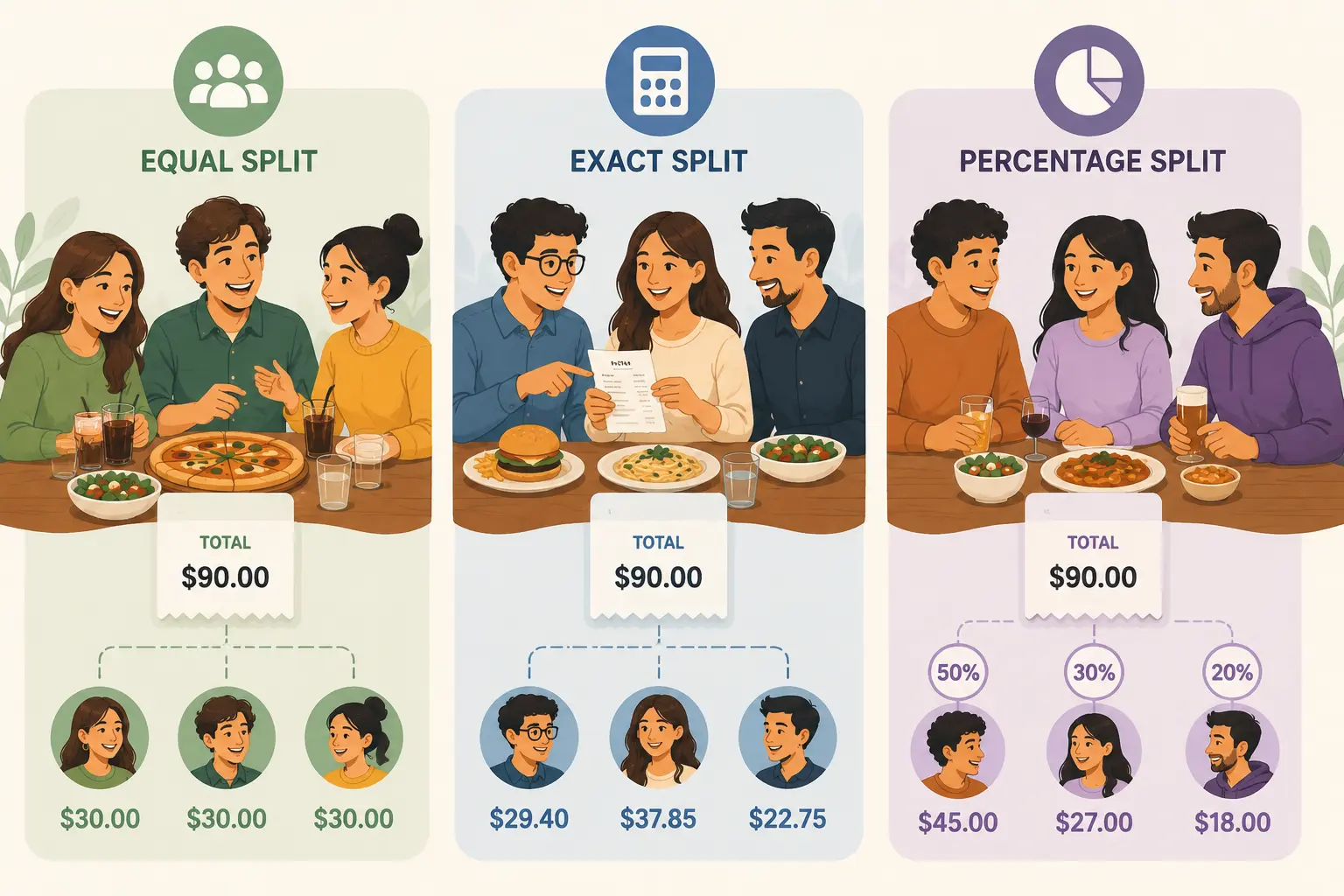
1. Split Bills Equally
Best for: restaurant meals, pizza nights, utilities, subscription services, small group expenses.
This is the simplest method - everyone pays the same amount.
Example: dinner costs $120 for four friends. Everyone pays $30 each. Simple, fast, no calculations.
Pros: easy to understand, quick, no discussions.
Cons: doesn't work when people consume different amounts.
2. Split by Exact Amount
Best for: restaurants, shopping, groceries, shared orders.
Instead of dividing everything evenly, each person pays for exactly what they used.
Example - restaurant bill:
| Person | Amount |
|---|---|
| Alex | $24 |
| Sam | $18 |
| Mia | $42 |
| Chris | $16 |
Each person pays only their own portion. This is often the fairest method when purchases vary significantly.
3. Split by Percentage
Best for: couples, families, different income levels.
Some households prefer to contribute based on income.
Example: monthly expenses of $2,000, where Partner A earns 70% of household income and Partner B earns 30%. Instead of paying $1,000 each, they pay $1,400 and $600. Many couples find this approach feels more balanced over time.
4. Rotate Who Pays
Best for: coffee, lunch, casual outings.
Instead of tracking every dollar, people simply take turns paying - Sarah pays Monday, James pays Tuesday, Emma pays Wednesday. This works well when costs remain relatively similar over time.
5. Track Everything Throughout the Month
Instead of settling every expense immediately, record everything and settle once per month. This is especially useful for roommates, couples, and shared households.
Rather than sending ten payment requests every week, everyone settles one final balance. Apps like Squara make this easy by automatically calculating who owes whom as expenses are added.
6. Use an Expense Splitting App
If you're still using spreadsheets or group chats, you're making life harder than it needs to be. A good expense-sharing app can:
- Track every purchase
- Calculate balances automatically
- Handle unequal splits
- Support multiple currencies
- Maintain a shared history
- Keep everyone looking at the same numbers
For households or travel groups, this often removes the biggest source of confusion.
Splitting Bills with Roommates
Roommates usually share rent, electricity, internet, water, groceries, and household supplies.
The easiest approach is to record expenses as they happen instead of trying to remember them weeks later. Recurring expenses - such as rent or internet - are especially helpful to automate.
Splitting Bills as a Couple
Every couple has a different approach. Common methods include 50/50, income percentage, one shared account, or alternating payments.
The most important part isn't the formula - it's agreeing on it together.
Splitting Bills While Traveling
Trips generate dozens of shared expenses: hotels, fuel, food, attractions, transportation, shopping.
Rather than settling after every purchase, most travel groups simply log expenses throughout the trip and settle once everyone gets home.
Splitting Restaurant Bills
Restaurants are where disagreements happen most often. Good options include an equal split, paying for what you ordered, or separate checks if available.
Avoid asking someone who ordered a salad to subsidize three steaks and a bottle of wine.
Common Mistakes to Avoid
Waiting too long - the longer you wait, the harder it becomes to remember purchases accurately. Record expenses immediately whenever possible.
Assuming everyone remembers - nobody remembers who bought coffee three weeks ago. Keeping a shared record eliminates arguments.
Ignoring small purchases - coffee, parking, cleaning supplies, snacks. These often become the biggest source of imbalance over several months.
Changing expenses without telling others - transparency matters. Everyone should know when expenses are added, edited, or settled. Apps with activity history make this much easier.
Which Method Is Right for You?
| Situation | Best method |
|---|---|
| Dinner with friends | Equal split |
| Restaurant with different orders | Exact amounts |
| Couple with different incomes | Percentage split |
| Roommates | Monthly expense tracking |
| Travel | Shared expense tracker |
| Casual coffee | Rotate payments |
Why an Expense Splitting App Makes Things Easier
While you can split bills using calculators or spreadsheets, dedicated apps automate nearly everything. Instead of manually calculating balances, they keep a running total, calculate who owes whom, support flexible splitting methods, store expense history, sync across devices, and reduce misunderstandings.
For groups that share money regularly, this quickly becomes more convenient than spreadsheets.
How We Split Bills at Squara While Building the App
While building Squara, I noticed most arguments about shared expenses weren't really about the math - they were about people remembering things differently. Someone's sure they paid last time; someone else is sure they didn't. That's why Squara keeps a complete history of every expense and requires the other person to confirm a settlement before it's recorded. When everyone's looking at the same information instead of relying on memory, there's a lot less to argue about.
Final Thoughts
There's no single "correct" way to split bills fairly. The best method depends on your relationship, spending habits, and the types of expenses you're sharing.
For occasional dinners, a simple equal split may be enough. For roommates, couples, or travel groups, tracking expenses over time usually leads to fewer misunderstandings and a more accurate picture of who owes what.
Whatever method you choose, consistency and transparency matter far more than the exact formula. Agree on the approach early, record expenses as they happen, and make sure everyone has access to the same information.
If you're splitting costs across an entire group rather than one bill at a time, see How to Split Group Expenses for the group-specific version of this guide, or, if you're living with roommates specifically, our Best Apps for Roommates roundup, or, if it's a partner rather than a roommate, our Best Expense Apps for Couples roundup. For the full landscape of expense tracking apps, see our Best Expense Tracking Apps guide.
Frequently asked questions
Continue reading
How to Split Group Expenses Fairly (Without the Stress) →Related articles
 Expense Sharing
May 29, 2026 · Artyom
How to Split Group Expenses Fairly (Without the Stress)
Learn how to split group expenses fairly with friends, roommates, and travel groups. Discover the best methods, common mistakes, and apps to simplify shared costs.
 Expense Sharing
May 25, 2026 · Artyom
Best Bill Splitting Apps (2026) – Top Apps to Split Bills Easily
Looking for the best bill splitting app? Compare the top apps for roommates, couples, travel, and shared expenses, including free options like Squara.
Expense SharingMay 23, 2026 · Artyom
Best Expense Splitting Apps (2026) – Compare the Top Bill Splitter Apps
Discover the best expense splitting apps for roommates, couples, travel, and friends. Compare features, pricing, and find the right app for sharing expenses.
Squara is available on iOS and Android
Download it now, or leave your email for product updates.